
When building APIs, integrating third-party services, or working with free website management tools, developers often face a familiar question:
Should I use JSON or XML?
At first glance, both formats do the same thing they structure and transmit data. But when you dig deeper, the differences affect performance, scalability, maintainability, SEO, and even security.
Some developers strongly prefer JSON for its simplicity. Others rely on XML for validation and enterprise-level integration. The truth? The better choice depends on what you're building.
In this guide, we'll break down:
Let's get into it.
JSON (JavaScript Object Notation) is a lightweight data-interchange format designed for simplicity and speed.
It represents data using:
Example:
JSON became popular because:
Most modern web applications, SaaS platforms, and even many free website management tools use JSON as their primary response format.
For debugging or validating syntax, using a JSON Formatter Tool helps clean up messy responses and detect structural errors quickly.
For official learning resources, refer to MDN Web Docs a trusted source for JSON standards and examples.
XML (Extensible Markup Language) is a structured markup language that uses nested tags to organize data.
Example:
XML is still widely used in:
For validation and readability, an XML Formatter Tool can help organize nested tags and prevent structural errors.
The official XML specifications are maintained by W3C, which sets global web standards.
At a structural level, the difference is obvious.
| Feature | JSON | XML |
|---|---|---|
| Structure | Key-value pairs | Nested tags |
| Readability | High | Moderate |
| File Size | Smaller | Larger |
| Validation | Limited | Strong (XSD) |
| Popularity in APIs | Very High | Moderate |
JSON is cleaner and more concise.
XML requires opening and closing tags, making it more verbose.
JSON:
XML:
Because JSON is less verbose, it's often preferred in bandwidth-sensitive environments.
Performance is where JSON typically wins.
JSON responses are usually 20-30% smaller than XML equivalents. Smaller files mean:
JSON parses faster because:
XML parsing requires additional processing due to nested tags and validation rules.
For API-driven tools like a Website SEO Score Checker, JSON significantly improves speed and responsiveness.
In competitive USA search markets, faster tools contribute to better user experience which indirectly impacts SEO performance.
Both formats can be secure, but misconfiguration causes vulnerabilities.
Proper input validation and secure parser configuration mitigate risks for both.
Security depends more on implementation than format.
JSON is ideal for:
If you're building modern free website management tools or integrating API responses into dashboards, JSON is typically the better choice.
XML is better for:
Search engines require sitemaps to be submitted in XML format. According to Google Search Central, XML sitemaps help search engines crawl and index content more efficiently.
So while JSON dominates APIs, XML remains essential for SEO and enterprise systems.
This is where many developers get confused.
Structured data guidelines from Google recommend JSON-LD as the preferred format for implementing schema markup.
So in SEO:
Both formats matter.
If you're new to development, JSON is easier to learn.
Why?
XML requires understanding nested hierarchies and schema validation.
Most modern IDEs support both formats, but debugging JSON feels simpler and faster.
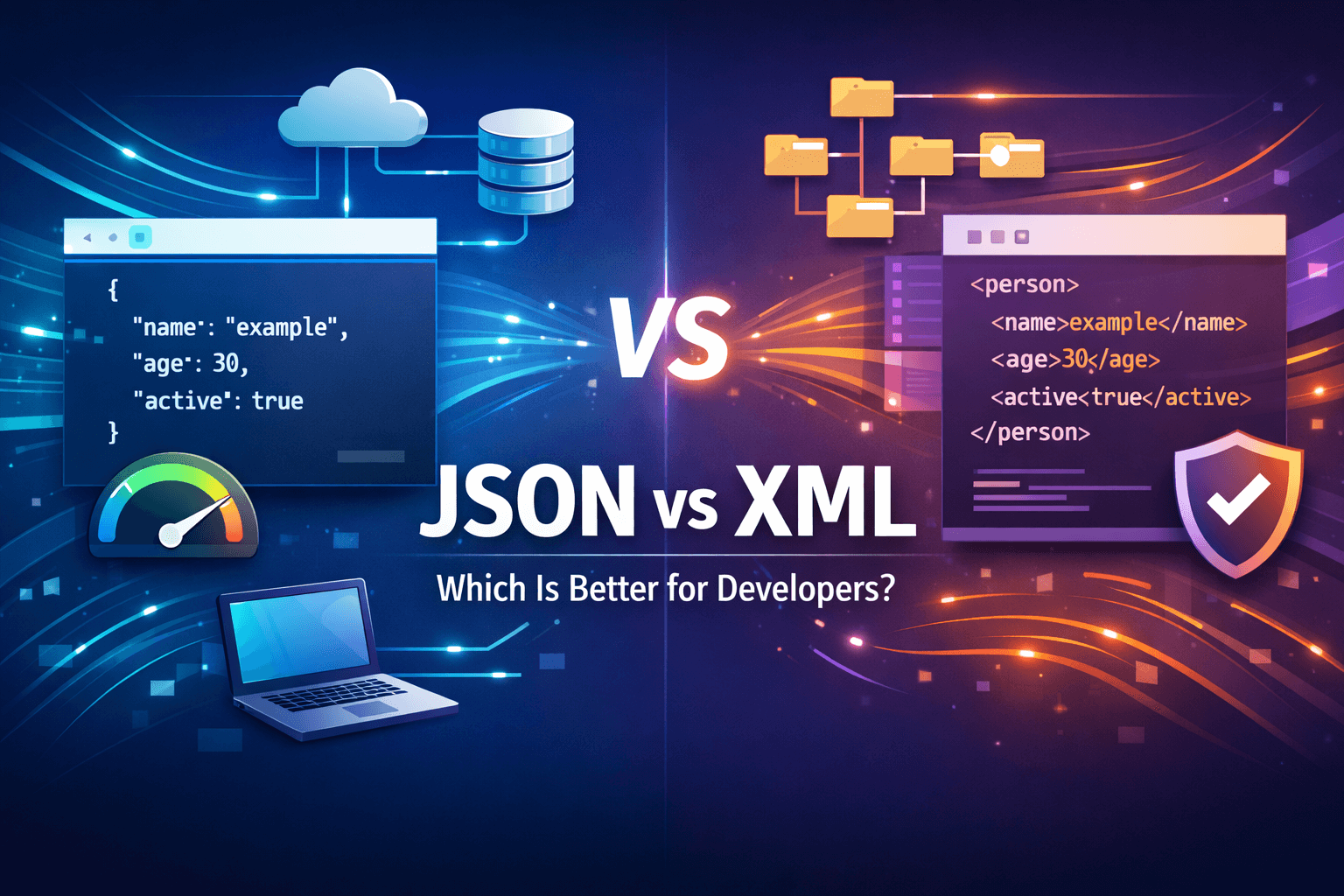
Let's compare the same data in both formats.
Notice how XML requires more characters and nested tags.
For APIs, JSON feels more natural.
For document structure, XML is more descriptive.
No.
JSON dominates modern APIs and web applications.
But XML remains essential in:
Each format has its place.
There isn't a universal winner.
Choose JSON if you're building:
Choose XML if you're working with:
Most modern developers use both depending on context.
Understanding when to use each format makes you a more versatile and effective developer.

Marketing is no longer split between “offline” and “online”. Today, the brands that win are the ones that connect both worlds seamlessly. One of the simplest yet most powerful tools making that connection possible is the QR code. From restaurant...

If you manage a website whether it's a blog, SaaS platform, eCommerce store, or agency project understanding IP addresses and DNS records is no longer optional. IP and DNS issues are behind many common problems: Website not loadingDomain not resolvingEmails...

In today's content-driven world, speed matters just as much as quality. Bloggers, marketers, researchers, and small business owners constantly work with screenshots, scanned documents, PDFs, and image-based text. Manually typing content from these sources wastes valuable time. That's where OCR...
Comments (0)