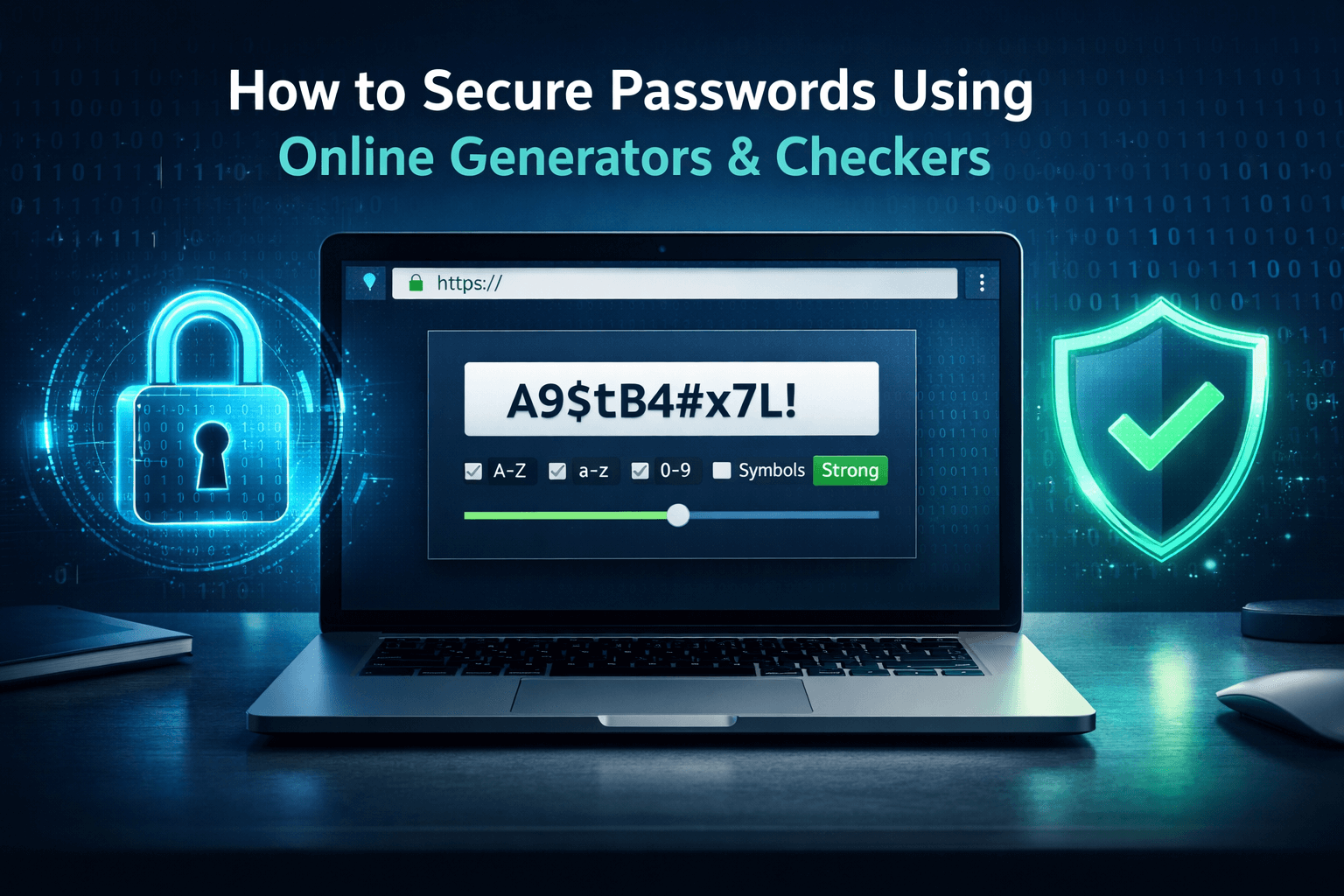

In today’s digital landscape, password security is no longer optional ,it’s essential. Whether you’re running a blog, managing client websites, or operating a small business, weak passwords remain one of the most common entry points for cyberattacks.
According to the NIST password security guidelines, poor credential management is still responsible for a large percentage of data breaches. And for website owners, a single compromised password can lead to:
Website defacement
SEO penalties
Malware injection
Loss of domain authority
Customer trust damage
If you're already using free website management tools to monitor performance and SEO, password protection should be part of that strategy.
This guide will walk you through:
What makes a password secure
How online password generators work
How password strength checkers evaluate security
Whether online generators are safe
Best practices for long-term protection
Let’s break it down properly.
Cyberattacks are more automated than ever. Hackers use:
Brute-force attacks
Credential stuffing
Phishing campaigns
Dictionary attacks
If you run a WordPress website, ecommerce store, or agency portfolio, your login page is a prime target.
Even tools like a Website SEO Score Checker or XML Sitemap Generator won’t help if your admin panel is compromised. Security must come first ,and that begins with strong passwords.
A hacked website can:
Lose rankings overnight
Get blacklisted by Google
Spread malware to visitors
Damage brand credibility
This is why password hygiene is directly connected to technical SEO and website management.
A secure password is not just “complex-looking”. It must meet specific security standards.
Modern security standards recommend:
Minimum 12 characters
Ideally 16-20 characters
Longer passwords increase entropy, making brute-force attacks exponentially harder.
For example:
Weak: Summer2024!
Strong: hT7#qL9!vX2@pR8$z
Length dramatically increases crack time.
Secure passwords should include:
Uppercase letters
Lowercase letters
Numbers
Special characters
Avoid predictable patterns like:
Name + birth year
CompanyName123
Admin@123
Hackers test these combinations first.
Many people create passwords that are easy to remember. That’s exactly what attackers expect.
Online generators create cryptographically secure random strings, which significantly improve strength.
Entropy measures unpredictability. The higher the entropy:
The harder it is to guess
The longer brute-force attacks take
Password strength checkers estimate this value and often show “time to crack”.
Even tech-savvy users make these mistakes:
If one site gets breached, attackers try the same password elsewhere.
Password1 → Password2 → Password3
Hackers expect this.
Saving in notes or spreadsheets is dangerous.
2FA adds another security layer.
Website owners often use performance tools like an HTML Minifier or Open Graph Generator, but ignore login protection.
Security should be part of your overall website management strategy.
An online password generator is a tool that creates secure, random passwords instantly.
It allows you to:
Choose password length
Include symbols & numbers
Avoid similar characters
Generate multiple options
These tools use randomization algorithms, often client-side, meaning passwords aren’t stored.
If you're already using tools like a QR Code Generator, URL Encoder Decoder or JavaScript Minifier, adding a password generator to your workflow is a logical next step.
A password strength checker analyzes:
Length
Complexity
Dictionary usage
Pattern repetition
Estimated crack time
They provide feedback such as:
Weak
Moderate
Strong
Very Strong
According to OWASP password best practices, passwords should resist automated cracking tools and dictionary attacks.
A reliable checker helps you evaluate this.
Here’s the safest way to do it:
Look for HTTPS encryption.
Longer is safer.
Include:
Symbols
Uppercase
Lowercase
Numbers
Disable “memorable mode.”
Never copy and forget.
After generating a password:
Paste it into a trusted strength checker
Check estimated crack time
Ensure no common patterns are detected
Avoid reusing older credentials
Some checkers analyze against known breach databases for extra safety.
This is a common concern.
Online generators are generally safe if:
They use HTTPS
Password generation happens client-side
They don’t store passwords
They are from reputable websites
For example, organizations like National Institute of Standards and Technology recommend focusing on length and randomness rather than outdated complexity rules.
Always avoid suspicious or unknown generator tools.
| Feature | Online Generator | Password Manager |
|---|---|---|
| Generates secure password | ✅ | ✅ |
| Stores passwords | ❌ | ✅ |
| Sync across devices | ❌ | ✅ |
| Encryption vault | ❌ | ✅ |
If you manage multiple websites using free website management tools, a password manager may be a better long-term solution.
Generators are ideal for:
Quick secure password creation
One-time credentials
Admin account resets
Many website owners don’t realize password strength affects SEO indirectly.
Here’s how:
Hacked sites:
Lose rankings
Show malware warnings
Get deindexed
Spam injections harm authority metrics.
Google prioritizes secure, trustworthy sites.
Security breaches cause outages, impacting crawlability.
Even if you're regularly using tools like:
Security must be foundational.
A compromised admin password can undo months of SEO work.
If you're running WordPress:
Rename default admin username
Limit login attempts
Enable 2FA
Use strong hosting security
Monitor login activity
Combine password best practices with:
SSL encryption
Regular backups
Malware scans
Secure hosting
Security and SEO go hand in hand.
Password security is not just a personal habit ,it’s a business necessity.
If you’re already leveraging:
Then securing your login credentials should be part of your overall free website management tools strategy.
Strong passwords:
Protect rankings
Prevent downtime
Safeguard customer data
Maintain website trust
Start with a secure generator.
Verify with a strength checker.
Store with a password manager.
Security is the foundation of sustainable seo success.

Marketing is no longer split between “offline” and “online”. Today, the brands that win are the ones that connect both worlds seamlessly. One of the simplest yet most powerful tools making that connection possible is the QR code. From restaurant...

If you manage a website whether it's a blog, SaaS platform, eCommerce store, or agency project understanding IP addresses and DNS records is no longer optional. IP and DNS issues are behind many common problems: Website not loadingDomain not resolvingEmails...

In today's content-driven world, speed matters just as much as quality. Bloggers, marketers, researchers, and small business owners constantly work with screenshots, scanned documents, PDFs, and image-based text. Manually typing content from these sources wastes valuable time. That's where OCR...
Comments (0)